
As a parent, few things are more agonizing than watching your child struggle. You see their bright curiosity, creativity, and affectionate nature—yet every day feels like a battleground. Morning routines are marked by tears, homework turns into hours of tears and shouting, and report cards arrive with recurring notes: “Does not listen,” “Easily distracted,” or “Constantly out of their seat.”
You might find yourself wondering: Is this just typical childhood energy? Am I failing as a parent? Or is there something deeper happening?
If you have found yourself searching for ADHD in children signs and treatment, take a deep breath. You are not a bad parent, and your child is not “defiant” or “lazy.”
Attention-Deficit/Hyperactivity Disorder (ADHD) is one of the most common neurodevelopmental conditions of childhood, affecting approximately 9.8% of children in the United States according to the Centers for Disease Control and Prevention (CDC). It is a biologically rooted difference in brain wiring—specifically involving the executive function network and dopamine signaling.
With timely evaluation and evidence-based care, children with ADHD can thrive academically, socially, and emotionally. In this comprehensive guide, we walk you through the core signs of childhood ADHD, how it is accurately diagnosed, and the full spectrum of treatment options available for your family.
What Is ADHD in Children?
ADHD is a complex neurodevelopmental disorder characterized by persistent patterns of inattention, hyperactivity, and impulsivity that interfere with functioning or development across multiple environments (such as both home and school).
It is not caused by poor parenting, too much sugar, excessive screen time, or a lack of discipline. Brain imaging studies have demonstrated that children with ADHD exhibit structural and functional differences in the prefrontal cortex—the region responsible for impulse control, working memory, emotional regulation, and planning.
Furthermore, children do not simply “grow out of” ADHD. When left untreated, childhood ADHD often transitions into adolescence and adulthood, manifesting as chronic underachievement, anxiety, depression, and low self-esteem. (To understand how this condition presents in older individuals, read our detailed guide on the signs of ADHD in adults).
The Three Presentations of Childhood ADHD
The Diagnostic and Statistical Manual of Mental Disorders (DSM-5) identifies three distinct presentations of ADHD:
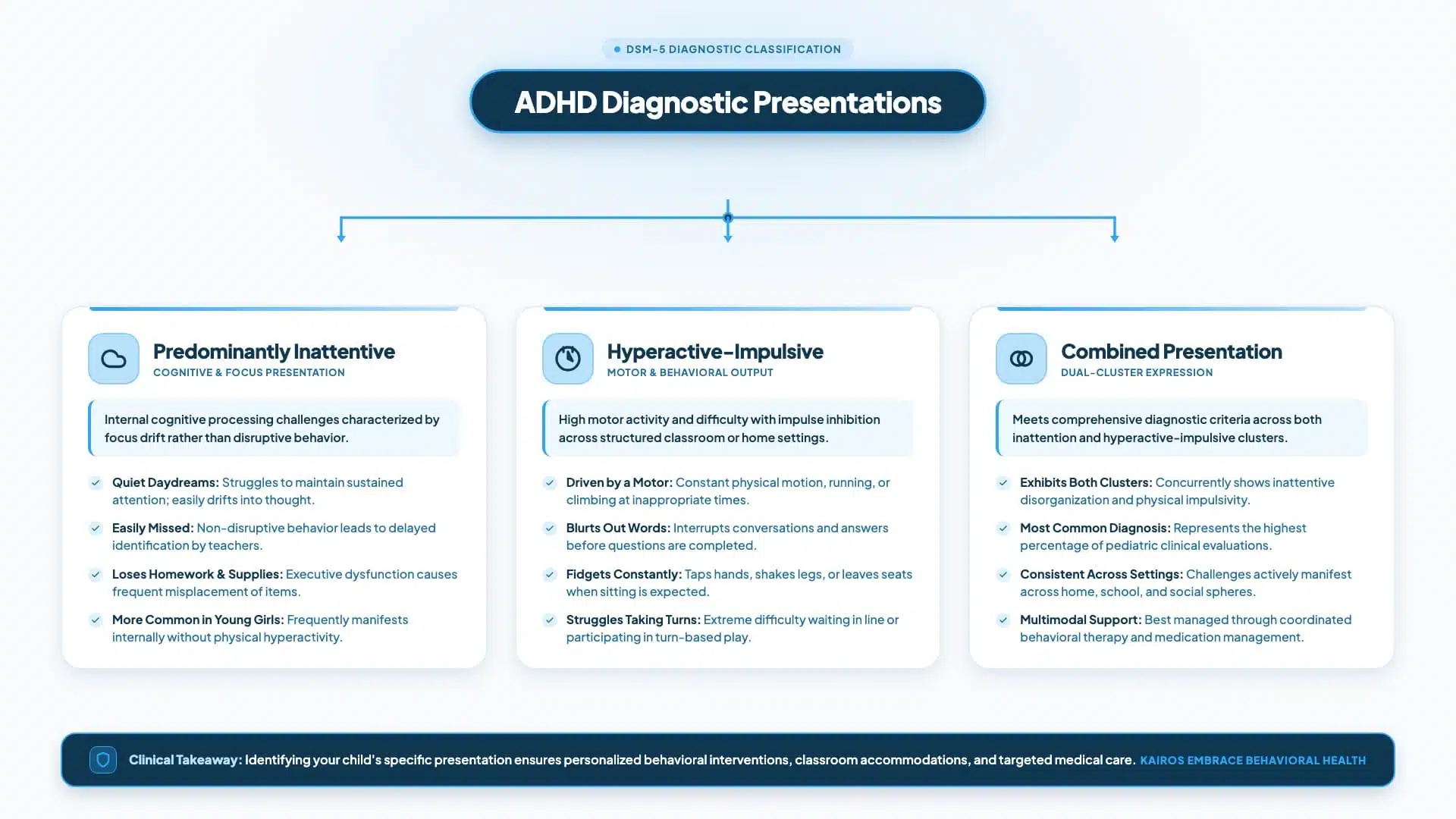
1. Predominantly Inattentive Presentation (Formerly Known as ADD)
Children with this presentation do not display disruptive or bouncing-off-the-walls behaviors. Instead, their challenges are internal and cognitive:
- Making careless errors on schoolwork despite understanding the material.
- Struggling to sustain attention on tasks or play activities.
- Seeming not to listen when spoken to directly (the “daydreamer”).
- Difficulty organizing tasks, materials, backpacks, and bedroom spaces.
- Losing essentials (jackets, lunchboxes, homework, pencils).
- Easily distracted by extraneous noises or unrelated thoughts.
- Chronic procrastination on tasks that require sustained mental effort.
Note for parents of girls: Girls with ADHD frequently present with inattentive symptoms rather than overt physical hyperactivity. As a result, they are often diagnosed years later than boys, sometimes suffering in silence from anxiety and low self-worth.
2. Predominantly Hyperactive-Impulsive Presentation
This presentation is characterized by excessive physical motor activity and difficulty inhibiting responses:
- Fidgeting with hands or feet, tapping, or squirming in seats.
- Leaving seats in classrooms or during meals when remaining seated is expected.
- Running or climbing in situations where it is inappropriate.
- Inability to play quietly or engage in leisurely activities calmly.
- Often “on the go,” acting as if “driven by a motor.”
- Talking excessively and interrupting conversations.
- Blurting out answers before questions are completed.
- Extreme difficulty waiting their turn in games or lines.
3. Combined Presentation
This is the most frequently diagnosed presentation, where the child meets criteria for both inattentive and hyperactive-impulsive symptom clusters for at least six months.
ADHD Signs Across Developmental Stages
Childhood ADHD symptoms evolve as children grow. Recognizing what to look for at each age helps you intervene early:
Preschool Years (Ages 3–5)
- Constantly in motion; climbs dangerous heights without fear.
- Cannot sit for even a short story or circle time.
- Aggressive play or intense tantrums when asked to transition between activities.
- Struggles to make or keep friends due to physical impulsivity.
Elementary School (Ages 6–11)
- Cannot finish classroom work without constant one-on-one redirection.
- Messy handwriting, disorganized desk, and lost homework assignments.
- Trouble retaining multi-step directions (“Put your shoes on, get your coat, and grab your backpack” leads to standing in the hallway with one shoe).
- Social difficulties due to interrupting games or intruding on peers.
Middle & High School (Ages 12–18)
- Chronic, severe procrastination and late assignments.
- Forgetfulness regarding commitments and daily responsibilities.
- Internal restlessness (fidgeting, leg bouncing, feeling an inner motor running).
- Emotional dysregulation—intense sensitivity to perceived rejection or criticism (Rejection Sensitive Dysphoria).
- Heightened risk for impulsive behaviors and driving accidents.
How Is ADHD Diagnosed in Children?
There is no single blood test or 10-minute quiz that can diagnose ADHD. A rigorous, professional evaluation by a licensed psychiatric provider (such as a Psychiatric Mental Health Nurse Practitioner or child psychiatrist) involves a multi-step clinical assessment:
- Comprehensive Clinical Interview: Reviewing developmental history, family medical history, prenatal factors, and current home dynamics.
- Standardized Rating Scales: Gathering objective behavioral checklists (such as the Vanderbilt or Conners Rating Scales) completed by parents, caregivers, and classroom teachers to verify symptoms exist in more than one setting.
- Differential Diagnosis: Rule out or identify co-existing conditions. Up to two-thirds of children with ADHD have a co-occurring condition, such as generalized anxiety, depression, learning disabilities (dyslexia), or oppositional defiant disorder (ODD). (Learn more about related types of mental illness)

Evidence-Based Treatment Options for Childhood ADHD
Effective ADHD treatment is multimodal. The American Academy of Pediatrics (AAP) clinical guidelines recommend a comprehensive approach combining behavioral therapy, school accommodations, parent training, and medication management.
1. Behavioral Parent Training (BPT)
Before or alongside medication, parent training provides families with specialized tools to manage ADHD behaviors constructively:
- Implementing visual schedules and predictable daily routines.
- Breaking multi-step instructions into clear, single-step tasks.
- Using immediate, positive reinforcement (token economies, specific praise) for desired behaviors.
- Creating calm, structured consequences rather than emotional punishments.
2. School Accommodations (504 Plans & IEPs)
Children with ADHD are legally entitled to educational accommodations under Section 504 of the Rehabilitation Act or through an Individualized Education Program (IEP). Common effective accommodations include:
- Extended time on tests and standardized exams.
- Seating near the front of the classroom, away from windows and doors.
- Movement breaks during extended lectures.
- Visual task checklists and permission to use audiobooks or digital notes.
- Chunking long assignments into manageable checkpoints.
3. Pediatric Medication Management
For moderate to severe ADHD, psychiatric medications are among the most effective and thoroughly researched treatments in medicine. Medications help normalize neurotransmitter levels (dopamine and norepinephrine) in the prefrontal cortex, enhancing focus, attention span, and impulse control.
- Stimulants (First-Line): Methylphenidate (Ritalin, Concerta) and Amphetamine salts (Adderall, Vyvanse). About 70–80% of children experience dramatic symptom improvement.
- Non-Stimulants: Atomoxetine (Strattera), Guanfacine (Intuniv), and Clonidine (Kapvay). Excellent alternatives for children who experience side effects from stimulants or who have co-occurring anxiety or tics.
Many parents feel anxious about starting psychiatric medication. It is vital to work with an experienced psychiatric clinician who specializes in what medication management in psychiatry involves, monitoring growth, appetite, and sleep with meticulous care.
4. Lifestyle and Nutritional Support
- Consistent Sleep Routines: ADHD brains struggle to regulate melatonin; a dark, cool sleep environment is crucial.
- Regular Aerobic Exercise: Physical activity naturally boosts dopamine and improves executive function.
- Balanced Nutrition: Meals balanced with protein and complex carbohydrates prevent blood sugar spikes and crashes that worsen inattention.
Compassionate Pediatric Behavioral Health at Kairos Embrace
At Kairos Embrace Behavioral Health, our mission is “Inspiring Hope, Restoring Lives.” We believe that every child is wonderfully made with unique gifts, creativity, and potential. An ADHD diagnosis does not define who your child is; it simply gives you the map to help them succeed.
Our practice offers specialized, family-centered behavioral healthcare across Maryland and Delaware:
- Comprehensive Pediatric & Adolescent ADHD Evaluations: Thorough, respectful evaluations that provide clear diagnostic answers without labeling.
- Expert Medication Management: Careful, conservative titration of medications with close monitoring to ensure optimal focus with minimal side effects.
- Supportive Therapy & Family Counseling: Helping children build emotional resilience and equipping parents with evidence-based behavioral strategies.
- Faith-Integrated Care: For Christian families, we offer compassionate spiritual support, reminding your child of their God-given identity and worth.
We welcome families in person at our clinics in Laurel, Maryland, Dover, Delaware, and Smyrna, Delaware, as well as through convenient telehealth appointments across Maryland and Delaware.
Explore our full clinical spectrum of services and learn about the diverse conditions we treat.
Give Your Child the Support They Deserve
You do not have to struggle through another school year of frustration and heartbreak. Compassionate, effective help is within reach.
Take the first step today by scheduling a free 15-minute consultation with our clinical team: