
When you are struggling with persistent mental health challenges—whether it is the suffocating weight of major depression, the racing heart and dread of panic attacks, the exhausting paralysis of adult ADHD, or unpredictable mood swings—you want relief that is safe, effective, and lasting.
For many people, therapy, exercise, and lifestyle adjustments provide valuable tools. Yet for millions of others, these efforts alone are not enough to lift the fog. You might hear a doctor suggest psychiatric medication, and an immediate wave of questions and anxieties arises:
- Will medication change my personality or make me feel like a zombie?
- Will I become addicted or have to take pills for the rest of my life?
- Who monitors these drugs to make sure they are safe for me?
These concerns are completely normal. The answer lies in understanding what is medication management psychiatry.
Psychiatric medication management is not simply receiving a prescription slip and being sent on your way. It is a highly specialized, ongoing collaborative clinical partnership with a licensed psychiatric medical provider. It ensures that any psychotropic medication you take is precisely tailored to your unique biochemistry, monitored with meticulous safety, and adjusted as your life evolves.
In this guide, we break down what psychiatric medication management entails, who provides it, how the process works step by step, and how Kairos Embrace Behavioral Health offers compassionate, whole-person care across Maryland and Delaware.
Defining Psychiatric Medication Management
In behavioral healthcare, medication management refers to the comprehensive clinical service of evaluating, prescribing, monitoring, and optimizing psychotropic medications to treat mental, emotional, and neurodevelopmental conditions.
Unlike a standard primary care visit that might last only ten minutes, psychiatric medication management is conducted by specialized mental health prescribers who understand the intricate pharmacology of the central nervous system.
The core objectives of psychiatric medication management are:
- Accurate Diagnostic Clarification: Ensuring the medication directly targets the underlying neurobiological condition rather than just surface symptoms.
- Personalized Treatment Selection: Choosing the safest, most effective medication based on your genetics, medical history, age, and lifestyle.
- Careful Titration: Starting at the lowest effective therapeutic dose to minimize potential side effects.
- Continuous Clinical Oversight: Regularly assessing therapeutic efficacy, tracking biological markers (such as blood pressure, weight, or metabolic labs), and managing drug interactions.
- Holistic Integration: Combining pharmacological therapy with psychotherapy, lifestyle modifications, and optional spiritual care for true whole-person restoration.
Who Provides Psychiatric Medication Management?
Prescribing psychotropic medication requires advanced clinical training and state medical licensing. In modern behavioral healthcare, medication management is primarily delivered by two types of specialized medical professionals:
1. Psychiatric-Mental Health Nurse Practitioners (PMHNPs)
PMHNPs are advanced practice registered nurses who have earned Master’s or Doctoral degrees in psychiatric nursing and behavioral medicine. Board-certified and state-licensed, PMHNPs conduct comprehensive psychiatric evaluations, diagnose complex psychiatric conditions, interpret lab tests, prescribe psychotropic medications, and provide individual psychotherapy. Known for their holistic, patient-centered nursing philosophy, PMHNPs are often praised for their warm, empathetic bedside manner.
2. Psychiatrists (MD or DO)
Psychiatrists are medical doctors who have completed four years of medical school followed by four years of specialized psychiatric residency. They specialize in severe psychiatric conditions, complex neurobiology, and polypharmacy.
At Kairos Embrace Behavioral Health, our medication management services are led by experienced, board-certified Psychiatric Mental Health Nurse Practitioners who combine clinical expertise with compassionate, dignified care.
How Medication Works in the Brain: Restoring Neurochemical Balance
To understand why medication management is so valuable, it helps to understand what psychiatric medications actually do.
Mental illnesses—such as depression, anxiety, OCD, and ADHD—are not character flaws. They are medical conditions that often involve disruptions in brain communication networks and chemical messengers known as neurotransmitters:
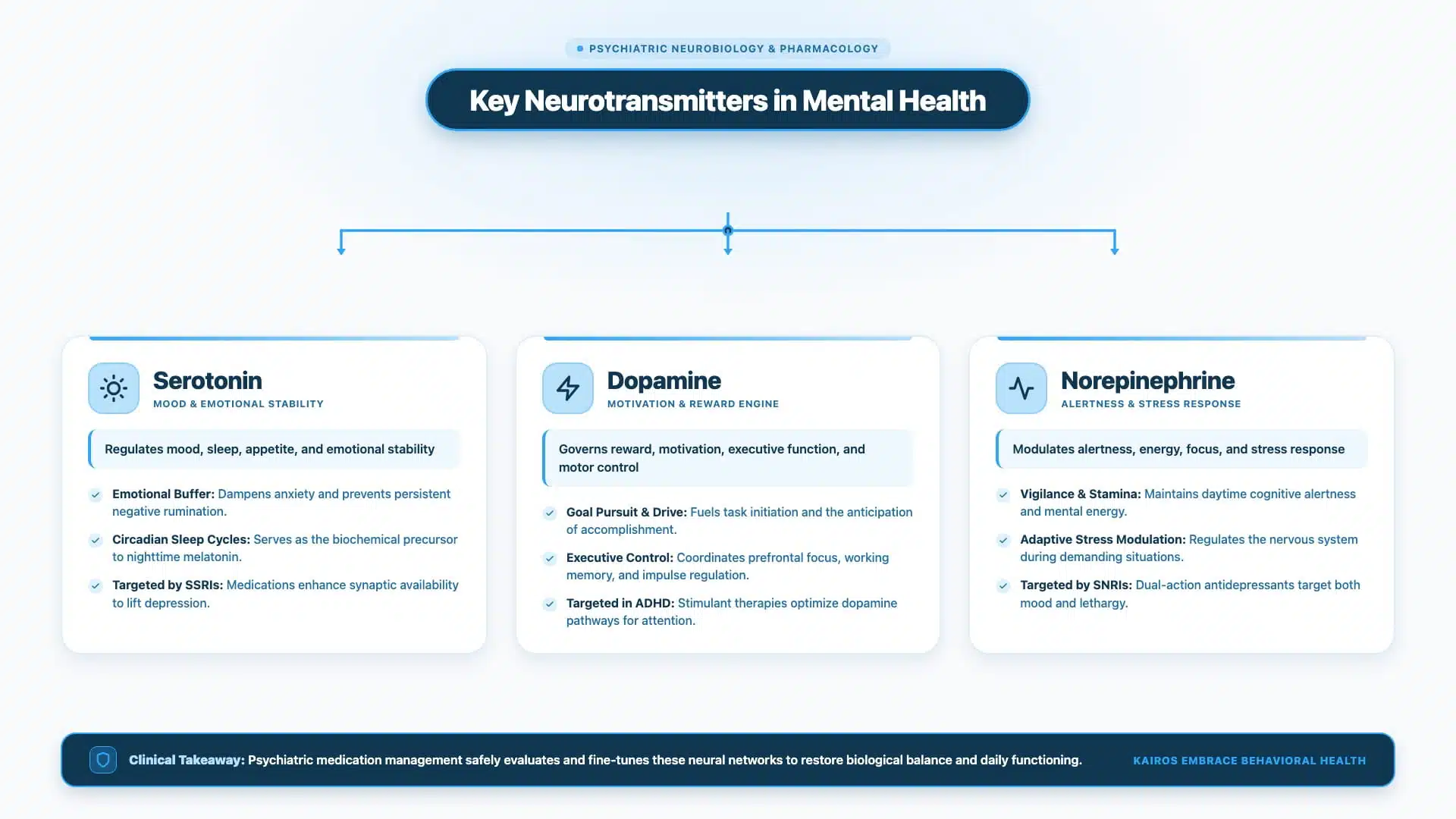
Psychotropic medications do not create an artificial personality; they help restore optimal signaling across these synaptic pathways. For example:
- Antidepressants (SSRIs / SNRIs): Prevent the premature reabsorption of serotonin and norepinephrine, allowing your brain cells to communicate more effectively and lifting chronic depressive numbness.
- ADHD Stimulants & Non-Stimulants: Optimize dopamine and norepinephrine availability in the prefrontal cortex, enhancing focus, impulse control, and executive function.
- Mood Stabilizers & Anxiolytics: Calm overactive neuronal firing, preventing manic peaks, deep depressive crashes, or overwhelming panic sensations.
When brain chemistry is stabilized, you regain the cognitive clarity and emotional energy necessary to actively engage in therapy, work, and family life.
The Step-by-Step Medication Management Process
What can you expect when you begin psychiatric medication management at Kairos Embrace? The journey follows a structured, collaborative protocol:

Step 1: The Initial Psychiatric Evaluation (60 Minutes)
Your first appointment is a comprehensive, deep-dive evaluation. Your psychiatric provider will discuss:
- Your current symptoms, when they began, and how they impact daily living.
- Personal and family psychiatric history (genetics play a major role in medication response).
- Past medication trials, including what worked and what caused adverse effects.
- Medical conditions, allergies, and all current supplements or prescriptions.
- Lifestyle factors, sleep patterns, substance use, and personal values.
Step 2: Collaborative Treatment Planning
Medication is never forced upon you. Your provider will explain potential medication options, discuss why a specific medication is recommended, outline expected benefits, review potential side effects, and answer every question you have. Together, you agree upon a customized care plan.
Step 3: Conservative Dosing and Starting Treatment
We follow the proven medical principle: “Start low and go slow.” Starting at a conservative dose allows your body to adjust gently while minimizing the risk of uncomfortable side effects.
Step 4: Regular Follow-Up Appointments (15–30 Minutes)
In the initial weeks, follow-up visits occur every 2 to 4 weeks. During these visits, your provider evaluates:
- Are your symptoms improving?
- Are you experiencing any physical side effects (nausea, insomnia, headaches)?
- Do we need to titrate the dose or give it more time to reach a steady state?
Once you achieve clinical stability and feel like yourself again, follow-up visits typically transition to every 2 to 3 months for routine maintenance and prescription refills.
Step 5: Tapering and Discontinuation (When Appropriate)
Psychiatric medication does not always have to be a lifelong commitment. For many individuals navigating a single episode of depression or situational anxiety, medication serves as a temporary bridge. When you are ready, your provider will design a slow, medically supervised tapering schedule to discontinue the medication safely without withdrawal symptoms.
Common Conditions Managed with Psychiatric Medication
Medication management is an essential pillar in treating a wide spectrum of psychiatric conditions:
- Major Depressive Disorder & Dysthymia: Restoring energy, interest, and emotional vitality. (Learn how to find a therapist near me for depression).
- Anxiety Disorders & Panic Disorder: Quieting persistent dread and somatic panic attacks.
- ADHD in Children & Adults: Improving focus, organization, and emotional regulation. Explore our guides on the signs of ADHD in adults and ADHD in children signs and treatment.
- Bipolar Disorder (I & II): Mood stabilization to prevent debilitating depressive crashes and manic episodes.
- Post-Traumatic Stress Disorder (PTSD): Alleviating hypervigilance, nightmares, and emotional flashbacks.
- Obsessive-Compulsive Disorder (OCD): Decreasing the intensity of distressing intrusive thoughts.
To learn more about each of these diagnoses, review our guide to the types of mental illness.
Debunking Common Myths About Psychiatric Medications
Misinformation and cultural stigma prevent thousands of people from receiving the relief they deserve. Let us address the most common myths:
| Common Myth | Clinical Reality |
|---|---|
| “Medication will change who I am.” | Proper medication does not change your core identity. It removes the exhausting symptoms masking your true personality. |
| “Taking medication means I am weak.” | You would not call someone with asthma weak for using an inhaler. Treating brain neurochemistry is medical wisdom, not weakness. |
| “I will get addicted to psychiatric pills.” | Most psychiatric drugs (SSRIs, SNRIs, mood stabilizers) are non-addictive and non-habit forming. |
| “Christians should only rely on prayer.” | God frequently uses medical science and skilled providers as instruments of healing. Review our perspective on faith-based counseling. |
| “I can stop taking medication the moment I feel better.” | Stopping abruptly often causes a rapid return of symptoms or discontinuation syndrome. Adjustments must always be medically guided. |
Compassionate Medication Management at Kairos Embrace

At Kairos Embrace Behavioral Health, our motto is “Inspiring Hope, Restoring Lives.” We believe that psychiatric medication is a powerful tool for healing, but it is only one component of whole-person care.
What makes our medication management program unique?
- Integrated Behavioral Health: We offer psychiatric evaluations, medication management, and individual therapy under one roof, ensuring your medical and therapeutic care work in total harmony.
- Patient-First Collaboration: You are an active partner in your health decisions. We listen to your concerns, respect your boundaries, and never rush appointments.
- Faith-Integrated Respect: For Christian patients who have felt judged in secular healthcare settings, our providers offer a safe harbor where faith and medicine coexist comfortably.
- Flexible In-Person & Telehealth Access: Visit us at our modern clinics in Laurel, Maryland, Dover, Delaware, or Smyrna, Delaware, or schedule convenient, secure telehealth appointments from anywhere in Maryland or Delaware.
Learn more about our practice history on our about us page and explore our full range of psychiatric services and conditions we treat.
Experience Restorative Behavioral Healthcare
You do not have to endure debilitating emotional pain or mental exhaustion alone. With expert psychiatric medication management, a brighter, balanced tomorrow is within reach.
Schedule a free 15-minute consultation with our clinical team today: